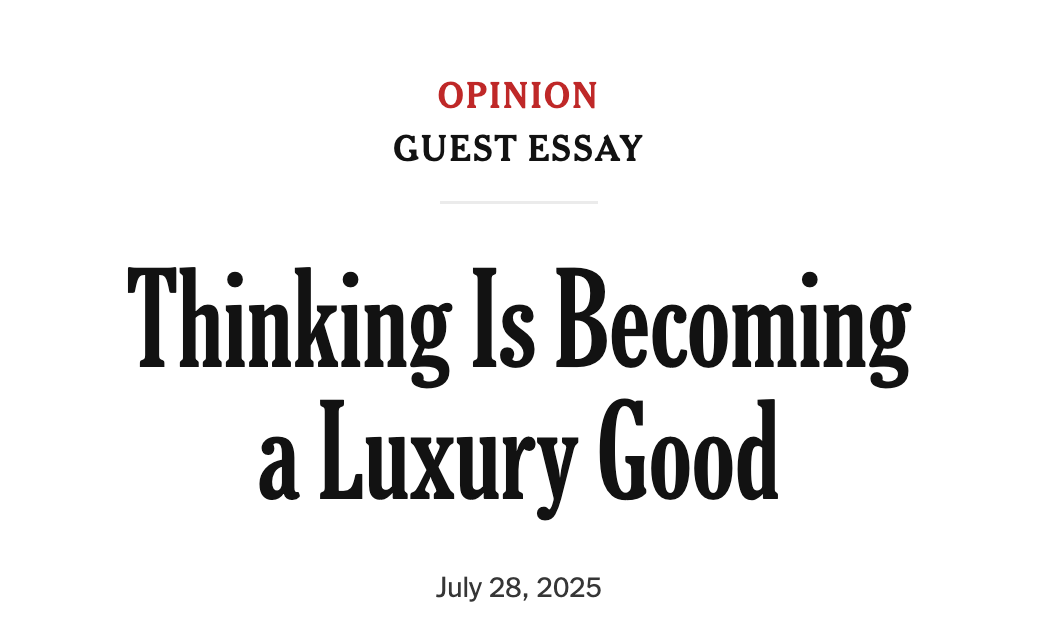
In a (relatively) recent opinion piece in The New York Times, “Thinking Is Becoming a Luxury Good,” British journalist Mary Harrington delves into the state of thinking in the modern day.
In the article, Harrington warns that the state of the internet (being flooded with brain rot, AI slop) and the effect your economic standing has on your health (physically and mentally), people are losing the want and need to think for themselves, and that it allows for dictators to manipulate citizens.
As a 15-year-old (arguably the second-most-affected age group by the internet/AI), I think the article is very insightful and highlights important issues people may not think about, but it misses a couple of things.
Harrington does point out that “… Tech notables such as Bill Gates and Evan Spiegel have spoken publicly about curbing their kids’ use of screens. Others hire nannies who are required to sign ‘no phone’ contracts, or send their kids to Waldorf schools, where such devices are banned or heavily restricted,” but it misses why they spend so much time on the internet: entertainment. Restricting the use of devices may increase their literacy or help their cognitive abilities develop, but it doesn’t fix what’s at the root of this. Children of every class need more than the restriction of their internet access; they need government intervention. But not in the way you might be thinking. Children spend time on the internet to entertain themselves when they could be spending that time doing hands-on activities; activities that their parents can’t afford. This could be a change that is made in the classroom. More financial support for art in schools and more diversity in what kids can choose to do, like the magnet programs we have here at Skyline.
More so, a part of the reason younger kids are spending so much time on the internet is because of the pandemic. Kids who were born into COVID-19 and were toddlers during it may feel more inclined to choose the internet over a person for companionship because they spent their core childhood years isolated. That’s their normal. Instagram, TikTok, YouTube, being on a screen.
For an article talking about the online world, it’s incredibly weird that it doesn’t mention the COVID-19 pandemic. The quarantine order left people stuck at home with nothing but the internet to keep them connected with the outside world, so it’s no surprise that people have become quite attached to the internet. The internet has become a safety blanket where you can drop all your worries and slip into blissful ignorance. The disconnect between people causes a lapse in people’s abilities to connect with one another, which has led to people forming more para-social (a relationship in which you know more about the other person than they know about you, typically with celebrities) relationships than talking to the people they’re close to. This pushes people away from talking with each other face-to-face and towards the internet.
Every aspect of the modern world is choking on AI and all its great abilities. It can take notes for you, compose an email, make a presentation, and write an essay. With everything that it can do and how much it’s marketed to you, it’s no surprise people would rather talk to ChatGPT about their mental health issues than get an actual therapist.
Then there’s the missing piece of AI and how lower incomes affect people’s emotional state of wanting. People can’t get a job to afford “luxuries” like pursuing art as a profession or taking vacations to relax. In a time when people don’t need to work, people must. AI has become the ultimate worker; it doesn’t need time off, it doesn’t need healthcare, all it needs is energy (and all your local water). This should mean a lower number of people having multiple jobs, and of people having to work overtime. But instead, AI is being groomed to be able to replace workers. The only thing AI can’t do, as far as jobs go, is manual, empathic, or social labor.
What we should be seeing with AI and all its abilities is assistance, not replacement. Instead of having to get an office job, people should be able to spend more time expressing themselves, but they can’t. Instead of the value and importance of art being acknowledged, it’s thrown in as just another thing AI can do. AI voice actors, animators (neither of whom need a director, they don’t even need scripts).
We are currently living through a time of extreme global and national change, for better and for worse. The increased use of social media has allowed people to escape into corners and just not think. Though it’s done as a form of self-protection from stress, it enables ignorance to grow and for the brain’s cognitive abilities, such as problem-solving or critical thinking, to wither. And while this isn’t the problem for the majority, that doesn’t mean it can be ignored. Now, when the government is denying the constitution that bids it and is actively lying, it’s crucial to keep your brain positively stimulated. The only solution for it is to face what makes you uncomfortable and to start having more grounded conversations with people face-to-face.