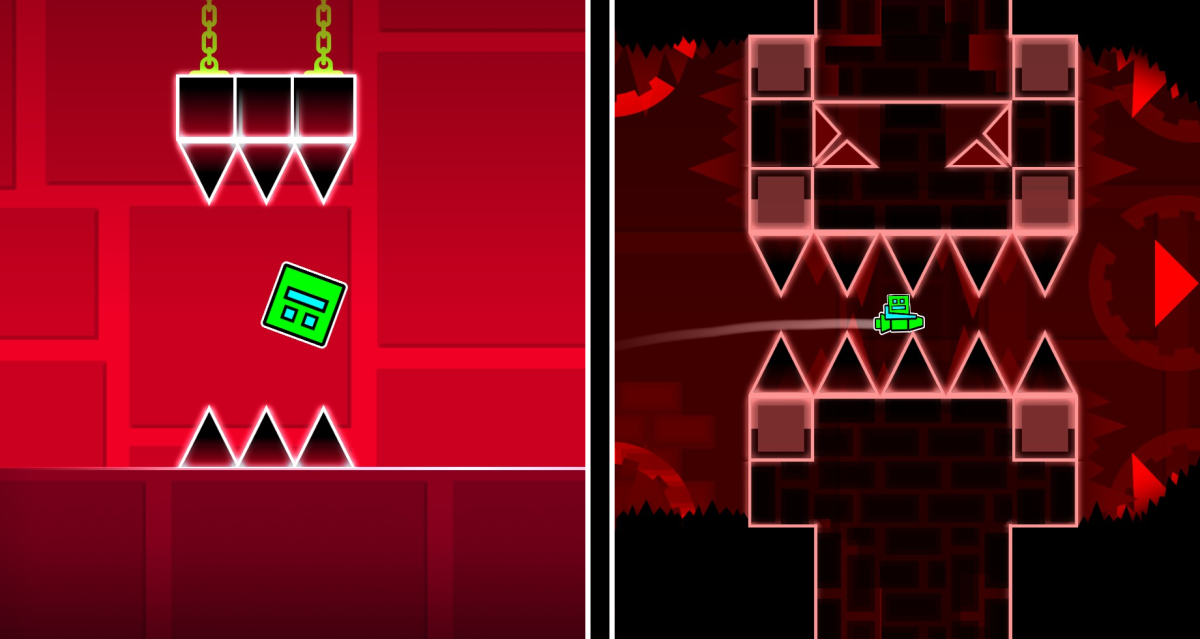
With RobTopGames’ mobile and computer game Geometry Dash averaging over 100,000 players daily, many students have decided to pick up Geometry Dash as an activity for their free time due to its variety of fun and entertaining gameplay.
Consisting of tens of thousands of individual levels of varying difficulty, Geometry Dash has little limit on what you choose to play. With only one button to press to dodge obstacles in order to complete levels, how hard could it really be? The lack of complexity in your inputs allows for a lot more difficulty when using that input relative to other games that use several. Due to the difficulty of the game, progression is a very important part if you want to get better.
Geometry Dash’s difficulty categories range from auto levels to demons, with demons having five subcategories known as easy, medium, hard, insane and extreme. But where should you start? A very obvious option is to just play the built in levels. These will help you get a grasp on the mechanics and introduce you into the game.
Many user created beginner demons people choose have played notable parts in the games history. Of these, my favorite one might just be the level B. Despite being released almost 6 years ago, B has decoration that really holds up well to today’s standard, with the level being themed about bees. It does a great job at teaching you fun, fast paced gameplay, with a challenging wave part toward the end and several tough timing based clicks, while still being on the easier end of medium demons.
“My first demon was ‘Broken Gameboy’ by Voxicat. I decided to beat it as my first demon because the beginning was really easy and I liked the song. Not long after, I met someone who had just beat ‘Ultra Violence’ by Xender Game. I was super impressed, so I immediately began trying to beat Ultra Violence too. It took me about a month but I finally beat it and I was so happy,” commented Owen DeVries (‘27).
Broken Gameboy is an easy demon who leans very much into the story of the player attempting to escape a gameboy while a hostile virus is attempting to catch them. The level opens with an 8-bit styled gameplay segment before a nice transition into where the rest of the level takes place, the inside hardware. The gameplay itself is smooth, syncing to the music to create a fun dynamic playing experience, with a tricky dual in the middle.
Meanwhile, the medium demon Ultra Violence has one of the most infamous boss fights ever created. The theme is similar to that of Broken Gameboy, where you must escape a factory while the boss tries to hunt you down. Ultra Violence has several sections requiring high clicks per second, and the boss fights utilize a lot of practice due to how fast paced they are.
While you aren’t obligated to follow these recommendations and you should play what you find fun, they are some of the more popular levels people play, and for good reason. For those who haven’t played Geometry Dash before, I would recommend it for the large variety of levels you can encounter.