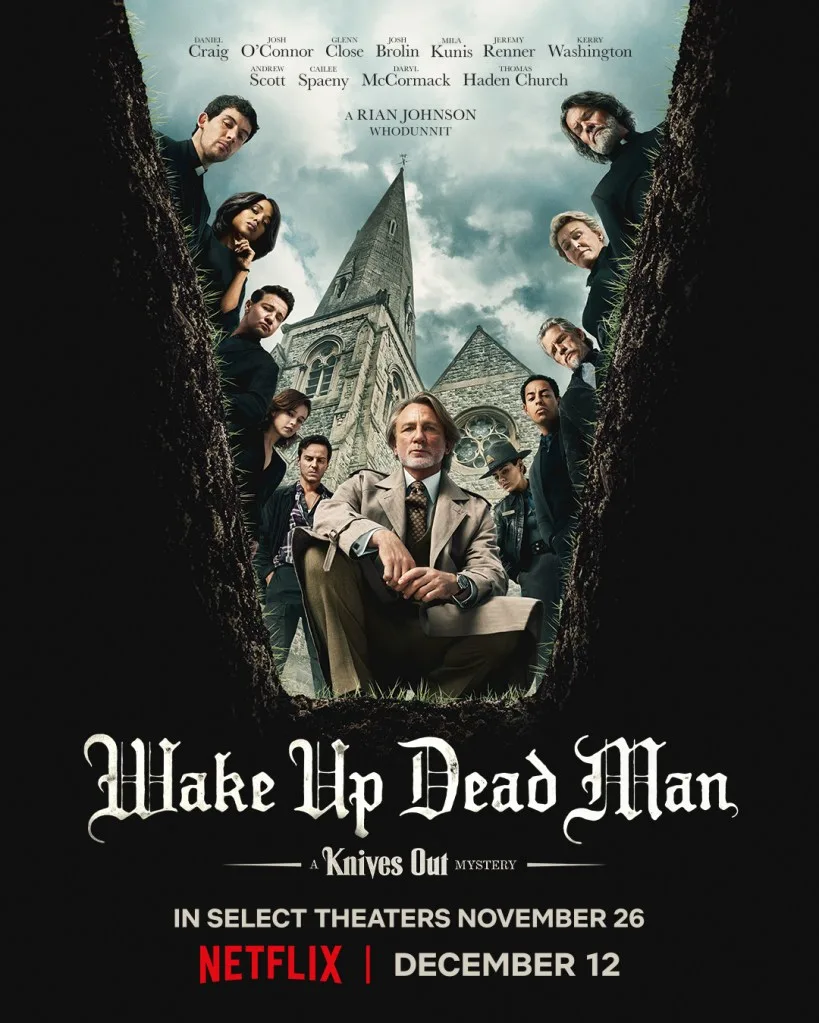
<em>Wake Up Dead Man: A Knives Out Mystery</em> (2025) trades the eccentric and flashy wealth of Rian Johnson’s previous films in Knives Out for a faith-centered community with long-held secrets. This shift allows Dead Man to be the darkest, most emotionally in-depth movie in Johnson’s franchise yet, reminding us that there is always hope in the darkest places to cut through the darkness.
Dead Man is the third installment in the series, following Knives Out (2019) and Glass Onion (2022). Dead Man shifts to personal problems and character depth, making it the best movie in the franchise in my opinion.
Dead Man follows the lead, Josh O’Connor as Reverend Jud Dupenticy, who is sent to Our Lady of Perpetual Fortitude, an odd Church in Chimney Rock, NY. O’Connor goes to work with Monsignor Jefferson Wicks (Josh Brolin), a strange and stubborn-headed priest who rules over his church with fear, guilt and shame to control the group of regulars. This fighting demeanor is in direct juxtaposition with O’Connor’s softer take on faith. The two instantly clash with one another, even getting in a physical altercation after O’Connor takes Wicks’ confession.
For much of Dead Man, Benoit Blanc (Daniel Craig) remains on the sidelines, allowing O’Connor to take center. O’Connor delivers a quietly powerful performance, as a man shaped by guilt, faith, and a past he can’t escape. O’Connor once killed a man in the boxing ring, fueling his search for forgiveness and giving the audience a deeper understanding of his inner conflict. O’Connor’s sense of inner conflict extends throughout the story in Wicks’ cruelty, Martha’s moral rigidity, Cy’s selfish ambition, and Nat’s resentment. Dead Man offers a surprisingly hopeful perspective, favoring empathy over hostility without becoming overly religious. The best Knives Out movie so far.
One of the film’s strongest aspects is its setting. Instead of eccentric billionaires or exotic locations, the mystery unfolds within a close community connected by a local church. The relationships feel personal, with long-standing grudges and histories. This intimacy makes every interaction feel loaded, and keeps the mystery rooted in human emotion rather than spectacle.
Daniel Craig delivers his best performance as Benoit Blanc to date. This version of Blanc feels more human, less performative and more reflective. He blends into the community rather than dominating it, often listening instead of leading. While the comedic timing remains sharp, the humor never undercuts the seriousness of the case. For the first time in the series, Blanc appears genuinely challenged, adding depth to a character audiences already love.
Johnson trusts the audience to piece the mystery together, laying out clues while also leading the audience down the wrong path and giving multiple seemingly impossible outcomes. Nothing feels overly explained. The mystery invites viewers to construct their own theories all the way to the end, making the audience pay close attention.
Three films in, Dead Man still feels fresh. It prioritizes strong themes of faith and community over flash, and delivers a mystery that still lingers. By embracing a deeper message to make the film tie into the previous two but delivering a new message, the film proves the Knives Out series still has plenty of potential to keep going.
If you enjoy murder mysteries with clever writing, layered performances, and films like Clue, Sherlock Holmes, or the previous Knives Out installments, this is for you. Older teens and adults will appreciate the mature themes and more thoughtful pacing. However, viewers looking for something purely lighthearted or action-driven may want to look elsewhere.