I’m sure you’ve heard about Aotearoa New Zealand, maybe on someone’s bucket list of places to visit or on a list of “top 10 most beautiful places in the world.” You’ve definitely heard of a kiwi fruit and maybe its namesake, the kiwi bird. However, do you know about the mischievous tuī or the silly pīwakawaka, the evil kāka? There’s a lot more to learn about Aotearoa than you might think.
My family is from Aotearoa New Zealand. We have six generations there. My mother moved to America to pursue higher education. However, wanting to be still connected to our roots, I fly every summer to Aotearoa to live with my grandparents until school starts. Last year, I decided to spend the first trimester of this school year at a slightly smaller public school, Hillcrest High School, as an exchange student. Unlike Skyline, Hillcrest was very diverse with many different ethnicities, which changed the environment of the school: the “cliques” weren’t formed by interests, or classes, but by ethnicity. I found the differences between schools weren’t big, but details started adding up.
One of the biggest contrasts I noticed was how the school treated their students; they cared about their mental and physical health, giving 30 to 60 minute breaks during the day and making sure they got fresh air by opening windows and doors and forcing kids outside during lunch. The school mandated that kids help clean the school, so a random subject would get chosen to clean every day, and if you were in that class, you would have to clean.
However, this mental health also went into the schooling. When I was in school, I would get similar assignments to Skyline, like a 500 word essay. Unlike Skyline, though, they would give us way more time than we needed; I got a month to work on that essay. It was the same with maths, we had a single 80 page assignment book that was supposed to be worked on the entire semester, yet I finished it in the first month. The environment never pushed for you to try your best, and for me, it was too easy.
In terms of classes, Hillcrest offers a considerably more diverse selection, from sewing and cooking, to calculus and Te Reo Māori. Unlike Skyline, where students can take whichever classes they want as long as they have taken prerequisites, students in Aotearoa aren’t allowed to take any classes other than those at their grade levels unless they are in a specialized school.
In Aotearoa, schools put more importance on every student having a chance to learn the subject as a whole, focusing more on everyone understanding the concepts than getting through the curriculum. This follows Aotearoa’s widespread ideology of equality, also known as Tall Poppy Syndrome: everyone is supposed to grow at the same pace and level, and no one is left behind. Yet, no one is allowed to excel or learn more than anyone else, thus cutting the “tall poppies” so that everyone is equal. In my experience, Tall Poppy Syndrome made excelling and learning as much as I could impossible–I was always held back by either my grade level being too low or the subjects in my classes being too rudimentary. For maths, we learned probability in one unit at Skyline, while at Hillcrest, we took a whole semester, and by the time I was done, there was nothing else I was able to learn in maths unless I went to university.
Another big difference in structure was the grade levels. Instead of grades, Aotearoa had years, starting from Year One and going to Year 13. Years one to six are spent in “primary school,” while students in years seven to eight are in “intermediate school.” Years nine to 13 are in “secondary school,” and can also be referred to as college or high school. Secondary school is then divided into two groups: juniors and seniors. Juniors form the first two years, and seniors make up the last three years of high school.
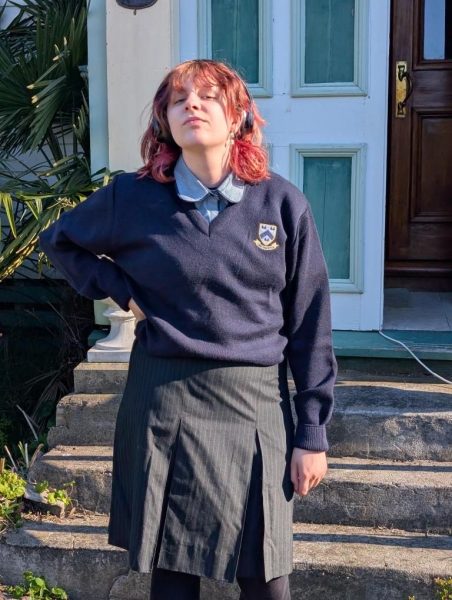
Each level has distinct uniforms because, unlike America, almost all public schools require uniforms. Uniforms can cost up to $200 NZD ($118 USD) for a set, and students often have to buy more than one set when switching years and schools.
School uniforms have many advantages and disadvantages. For example, uniforms help distinguish students and non-students, while casual clothing allows for more self-expression. I spoke to those who are currently in the school system as well as those who’ve graduated from it, and I seemed to get a consensus. While some said the cost of uniforms is quite hard on their families, all the people I talked to agreed that they preferred not having to think about what to put on every day. I personally found school uniforms to be quite limiting: no shoes could be above the ankle, only one pair of stud earrings could be worn at a time, no facial hair, no necklaces, rings, or bracelets. This made it very hard for me to express myself.
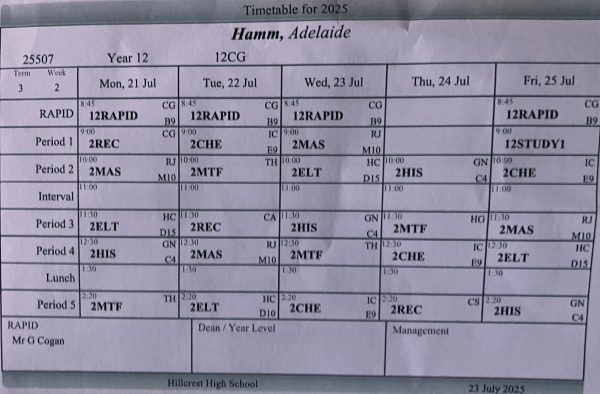
However, one of the aspects that made learning in Aotearoa easier was the schedule. In Hillcrest, not only do you have 60-minute classes, but you also have a 30-minute break time in the middle of the day, topped by an hour-long lunch break. On top of this, all of the hallways and cafeteria are outside, which is because the North Island doesn’t get below 0° C, allowing for students to have much healthier break times and a breath of fresh air.
All in all, school in Aotearoa New Zealand is more laid-back: whether for the good of the students, allowing them to sleep in, or for the worse, where students aren’t encouraged to perform to their best ability. If I were to create an ideal school system, I would combine them. Kids could wake up at a reasonable hour, have enough time to eat lunch every day, and take the classes they needed.