During registration for the 2025-2026 school year, many schedules were met with dismayed faces and an urgent drive for adjustments. As students took the Schedule Request Google Form by storm, 942 responses were recorded in the two-week period that the form was kept open.
Despite the $25 million deficit that hit Ann Arbor Public Schools in 2024, counselors report that the years prior have yielded a similar number of schedule change requests. “As budget cuts happen, what happens is our the building’s FTE (Full-Time Equivalent) numbers start to lower,” says Integrity Counselor Dennis Brunzell. “Principals have the job of distributing those FTEs in a way that makes sense.”
Budget cuts provided administration with additional restraints to consider when building student schedules. As a result of lower FTE, fewer courses run because of the lack of teachers to teach them. “The scheduling can be kind of tight when kids come [for schedule changes],” says Patterson. With less schedule-flexible elective courses available, it is more difficult to find courses to fill holes.
Schedule building comes down to the demand of students and the supply of teachers. In recent years, Skyline has seen the introduction of new electives such as Botany of Michigan Plants, Jewelry Making I, and Cybersecurity. “As long as there’s a demand for that class, and there are kids that are requesting that class, then the possibility of it running increases tremendously,” says Brunzell.
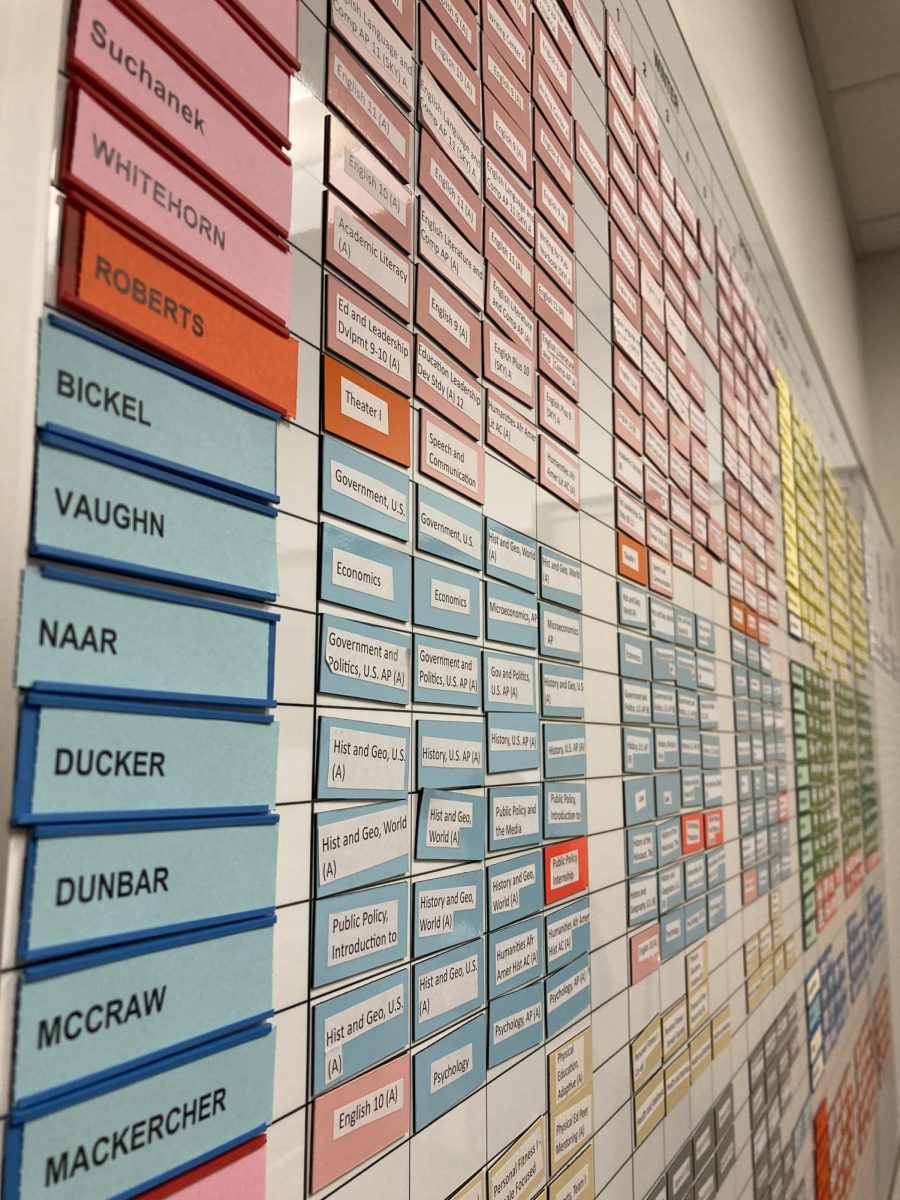
Brunzell describes building student schedules as a “sudoku puzzle”, starting first at the district level. The district identifies and approves courses before putting them on the AAPS catalog for student selection. “That doesn’t mean that we do offer it,” explains Brunzell. “This means that somewhere between Skyline, Huron, Pioneer, Community, it’s [available].”
The next step is in the hands of the student body: student requests. In February, counselors send out schedule request forms for students to select courses for the next year. “The building of the schedule is based off those requests,” says Brunzell. “The likelihood of you getting the classes that you want is directly aligned with whether or not you requested it at the front end.”
Student requests and other limiting parameters are put into PowerSchool by Skyline administration in the following summer. “There’s things that you have to input into the computer to make sure that when it’s building that schedule, it knows exactly what to do,” says SLC Principal Terri Patterson. This includes inputting details such as teacher availability, class sizes, and room assignments.
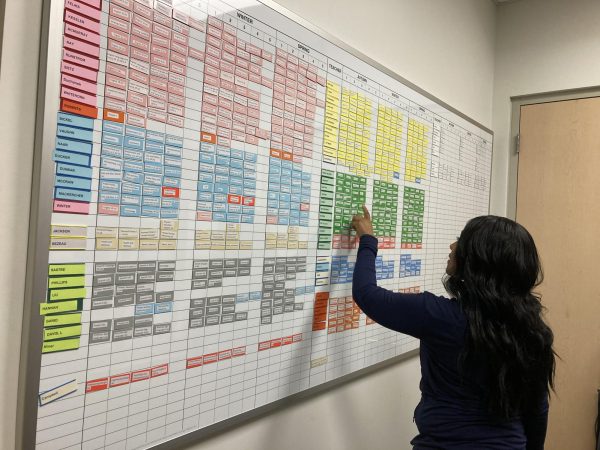
“PowerSchool literally runs millions of combinations,” says Brunzell. “It comes up with a master schedule, and it’ll spit out a number.” This number represents the percentage of student requests that were met, which administrators use to revise the master schedule and meet the highest possible percentage given the parameters. “A good schedule [is] if you can get 93-95% of the kids… You’re never gonna get 100%.”
“By the end of July, we have to have a schedule completely done and then ready to commit,” says Patterson. “Once you commit a schedule, the computer can’t do anything else for you.”
After the master schedule is committed in PowerSchool, it is released to the counselors for review. They look over individual schedules for errors such as holes, which is “where alternates are really important,” emphasizes Brunzell. “If we can’t get you your first choice, the computer will then do what it can to give you those second choices.”
When students receive a course on their schedule that isn’t what was requested, it’s often because the class periods of requested courses conflict with one another. “Either we have to look at classes that you didn’t request, or maybe you need to take an online class, or maybe we come up with something else creative,” says Brunzell.
For students who dual enroll at Skyline and another institution, filler courses are kept on their schedules prior to dual enrollment processes being finalized. “Once I reached out to [my counselor], he did the stuff pretty quickly,” says University of Michigan dual enrollment student Leah Barnocki (‘26). “I did have to figure out the logistics on my own, like payment.”