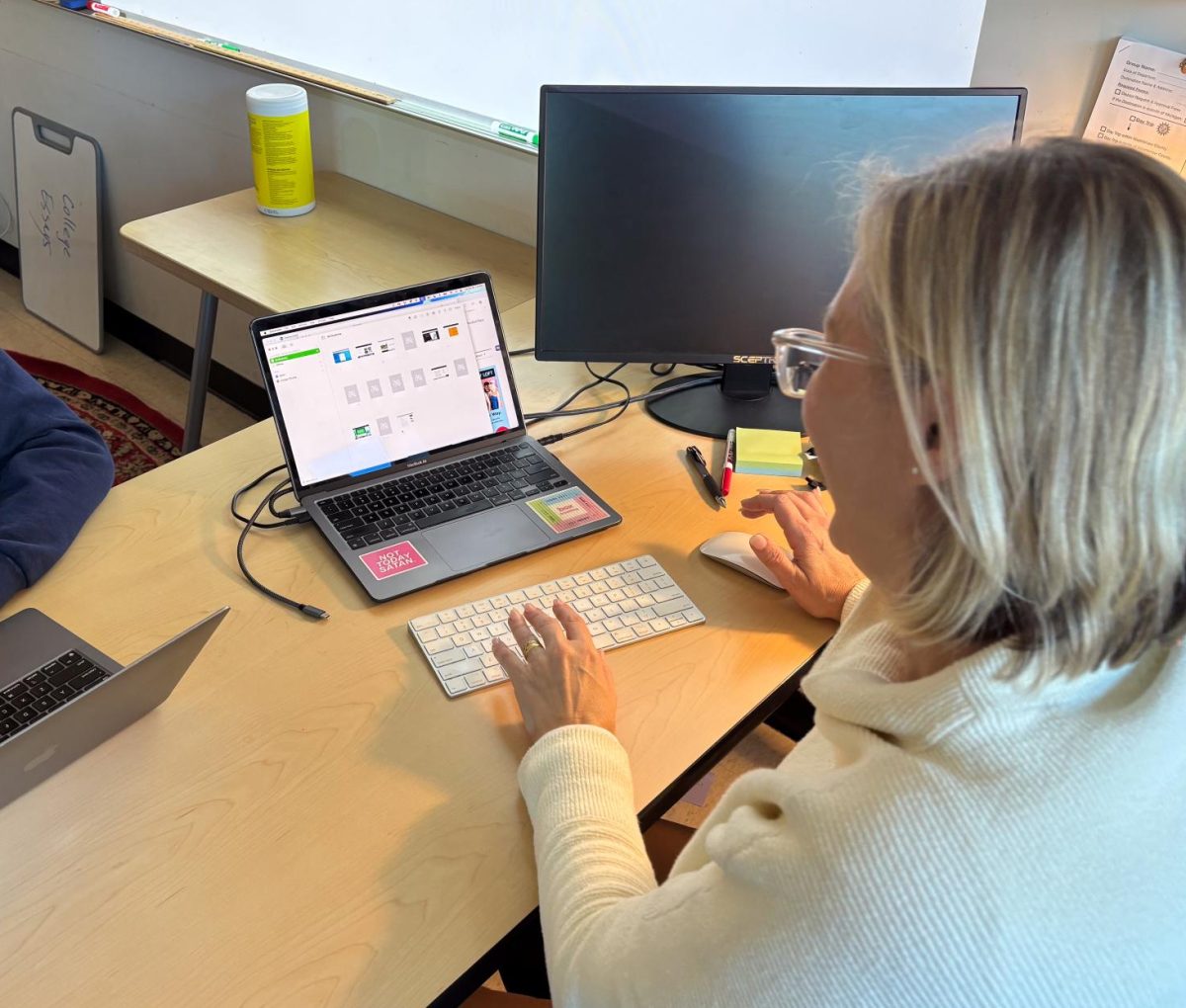
One day, a few weeks ago, as I was sitting in journalism class, stuck with no idea what to write about for my second story, a little dot showed up on my screen. Dr. Blais had opened Apple Classroom and could now see my screen. Seeing this, two things popped into my mind.
First, this is a story?
And second, how far does this surveillance go?
As it turns out, pretty far.
This year, AAPS high schoolers received brand new school-issued MacBooks to replace the old Chromebooks. They came with a built in system called Apple Classroom.
Through Apple Classroom, teachers can see everything you’re doing on your screen. When they end class, they get an overview of everything you were doing. Teachers can lock your screen, which makes your screen go black for the duration of the lock. They can open and close applications and mute your device. This gives your teacher near full control of your device. This power only works while you are in their room and have their class that hour.
Apple Classroom aims to make teaching easier by allowing students and teachers to mirror their screens and share links and assignments. However, the features that enhance collaboration are still finicky and do not work most of the time.
Right now, it seems Apple Classroom is mainly being used for surveillance. Many students feel teacher surveillance can be justified due to the amount of students cheating, playing games, or doing non-school activities during class.
“I personally don’t cheat,” says Henry Appel (‘26). “But people around me do…while it is important to regulate and catch cheaters, there are ways to do that without monitoring computers.”
Many students feel that Apple Classroom is a breach of privacy and that the school and its teachers should not be able to watch their screens. “It’s the same feeling as when your camera isn’t covered with tape or something, except it is much more real,” says Max Rosenberg (‘27). “A student having privacy on their screen should be a basic courtesy, and the contrary instills distrust and animosity between students and staff.”
Some students, however, believe that the school has a right to surveil the student body. “I think that since the school owns the computer it is fair that they can watch the computers,” says Dillon Bhuva-Trombley (28’).
Teachers appreciate the ability to monitor their students’ screens during class, keep them on task, and allow them to scan for cheating during tests. “I already have had one or two kids where something else is popping up on the screen when they should be doing the test, a la ChatGPT,” says science teacher Gabriel Retaliata. “So it’s like, okay, so you’re obviously trying to cheat. So I like being able to hopefully clamp down some of that.”
Teachers say that the ability to open applications and links on students’ computers is a benefit. They can send out to-do checklists for class that day that can streamline the learning process. “I can make a note in the Notes app and just make a checklist of things to do and push that checklist out,” says Retaliata, “So I think that could be useful for especially what might be a busy class period.”
While most teachers appreciate having a way to monitor their students computers, some think that Apple Classroom is lacking compared to the prior system, Securely. Apple Classroom doesn’t allow teachers to directly message students about their computer usage or close tabs.
“If you were doing something you shouldn’t have been doing, [with Securely] I could very easily just send you a message that would have said, like, Hey, what are you doing?” says math teacher Megan Stark. “I could also close tabs. You can’t do that on Apple.”
A final change with the new laptops: students are no longer allowed to use personal computers at school, per district policy, as they do not have Apple Classroom on them and cannot be monitored for cheating. Students who attempt to use non-school computers can get written up for noncompliance.
While some students are still bringing their personal computers to school, students should be aware of the possibility that enforcement policies may be getting stricter, similar to the way enforcement of the phone policy has changed in the past few years.