How do colleges check for AI on applications, and how accurate are they
Imagine pouring your heart into a college essay, only to have a computer label it artificial.
When writing college essays in 2026, it can be easy to rely on AI for quick components such as grammar, sentence structure, and more complex words.
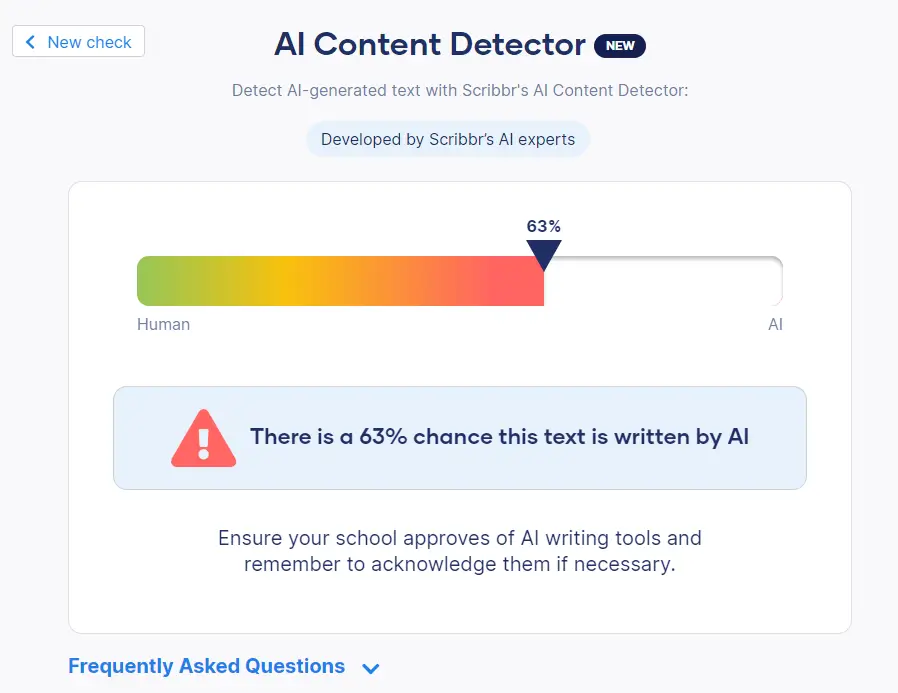
But is using AI in your essays worth it? The answer is no. US colleges and universities are starting to check for AI and plagiarism with professional tools, even if they aren’t yet 100% accurate.
What do these AI checkers look out for? Usually professional AI detectors try to highlight anything out of the ordinary such as the uniformity of sentence structures, writing patterns that sway from flawed human writing, and even wording diversity (Quetext, 2025). This means that colleges are looking for emotion.
Even the use of AI for a grammar check or punctuation scan can be dangerous. Even accepting Google’s grammar check suggestions can trigger these filters. Along with reporting accurate grammar, AI checkers flag anything they consider “predictable” writing (GPTZero, 2024). Universities use AI websites to check for plagiarism and AI. In some ways, it’s the perfect way for AI to recognize its own writing. The issue is that it may over-recognize correct writing as AI. Correct grammar? AI. Formal professionalism? AI.
Some students worry about their human writing. Many AI checking companies claim they have 99% accuracy, but they are far from foolproof. A recent study looked at 10 of the most popular AI checkers. On average, the AI detectors were only 60% accurate.
Finding a balance between professionalism and feeling can be difficult.
So what can you do?
- Make sure to keep your essay personal. While keeping your spelling and grammar neat and precise, make sure your writing is your own writing. Tell your story through your own words. Don’t let AI change your experiences into a rigid and lifeless clump of words.
- AI detectors can actually be used as a tool for some applicants. They can help students check if they have enough personal components along with professionalism.
- The Skyline Post’s advisor (and experienced college essay guide) suggests that you work to hear your own voice when writing. Tell a story that only you can tell. Your audience is a sympathetic person who doesn’t know you well yet. Read it out loud as you write and edit. If you feel comfortable saying it, and it sounds like you, it’s working.
- Use human editors: the learning center here at Skyline is an awesome resource, way more effective at helping you develop your voice, so you don’t end up sounding like a boring robot.